
Guide to Bug Defect Life Cycle in Software Testing 2025
- Gunashree RS
- Jul 23, 2025
- 8 min read

Software development has evolved tremendously over the years, but one constant remains: bugs are inevitable. Whether you're a seasoned quality assurance professional or just starting your journey in software testing, understanding the bug defect life cycle is crucial for delivering high-quality software products. This comprehensive guide will walk you through every aspect of bug management, from identification to resolution.
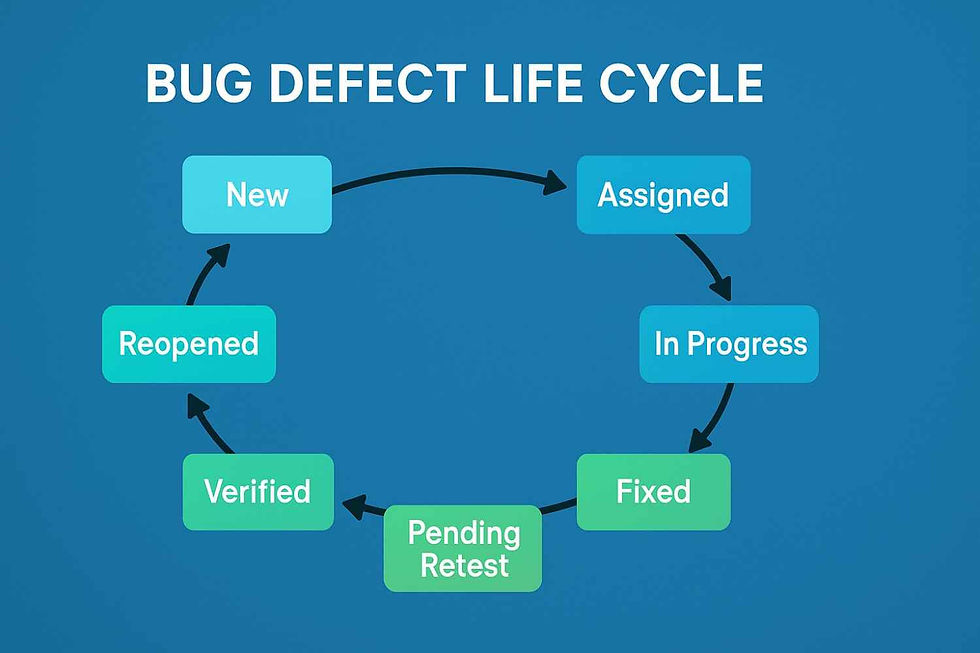
What is Bug Defect Life Cycle?
The bug defect life cycle represents the systematic journey that every software defect takes from its initial discovery to final resolution. Think of it as a roadmap that guides development teams through the process of identifying, documenting, fixing, and verifying software issues. This structured approach ensures no bug falls through the cracks and maintains software quality standards throughout the development process.
In today's fast-paced development environment, where agile methodologies and continuous integration are the norm, having a well-defined bug life cycle is more important than ever. It provides clarity, accountability, and ensures that all stakeholders understand their roles in maintaining software quality.
Understanding the Difference: Bugs vs Defects
Before diving deeper into the life cycle, it's essential to understand the subtle differences between bugs and defects, though these terms are often used interchangeably in the software industry.
Bugs typically refer to coding errors that cause unexpected behavior or system failures. They're usually discovered during testing phases and represent technical implementation issues.
Defects, on the other hand, encompass a broader category of issues including:
Functional deviations from requirements
Performance bottlenecks
Usability problems
Documentation inconsistencies
Design flaws
Understanding this distinction helps teams categorize issues more effectively and apply appropriate resolution strategies.
The Seven Essential Stages of Bug Defect Life Cycle
1. New/Discovery Stage
Every bug begins its journey in the "New" status. This is when a tester, developer, or end-user first identifies an issue during testing or normal software operation. During this stage, the bug is logged into a bug tracking system with essential details including:
Clear description of the issue
Steps to reproduce the problem
Expected vs actual behavior
Environment details (browser, OS, device)
Screenshots or video recordings
Severity and priority levels
The quality of information captured at this stage significantly impacts the entire life cycle efficiency.
2. Assigned/Triaged Stage
Once a bug is reported, it enters the triage phase, where project managers or team leads review the issue. They evaluate factors such as:
Business impact and severity
Resource availability
Current sprint priorities
Release timeline constraints
Based on this assessment, the bug is either assigned to a developer for immediate attention or moved to a different status, like "Deferred" or "Rejected."
3. In Progress/Active Development
When a developer begins working on the bug, its status changes to "In Progress." This stage involves:
Root cause analysis and investigation
Code review and debugging
Implementation of fixes
Unit testing of the solution
Documentation of changes made
Clear communication between developers and testers is crucial during this phase to ensure the fix addresses the root cause effectively.
4. Fixed/Resolved Stage
After implementing the solution, the developer marks the bug as "Fixed" or "Resolved." The code changes are typically merged into the appropriate branch, and the bug is handed back to the testing team for verification. This stage includes:
Code deployment to the testing environment
Preliminary verification by the developer
Documentation of the fix approach
Update of bug status in the tracking system
5. Pending Retest/Ready for Verification
The bug now awaits retesting by the quality assurance team. This stage serves as a queue for testers to verify that the reported issue has been properly resolved. It's a critical checkpoint that ensures fixes are thoroughly validated before considering the bug closed.
6. Verified/Closed Stage
During verification, testers execute the original test cases that identified the bug, along with regression tests to ensure the fix didn't introduce new issues. If the bug is successfully resolved, it's marked as "Verified" or "Closed."
7. Reopened Stage (When Necessary)
Sometimes, verification reveals that the bug hasn't been completely fixed or that the solution introduced new problems. In such cases, the bug is "Reopened" and cycles back through the development stages until a satisfactory resolution is achieved.
Key Stakeholders in the Bug Life Cycle Process
Understanding who's involved in each stage helps streamline the entire process:
Quality Assurance Testers:
Identify and report bugs
Verify fixes and close resolved issues
Perform regression testing
Maintain bug documentation
Developers:
Analyze and fix reported issues
Perform unit testing of solutions
Collaborate with testers for clarification
Document technical details of fixes
Project Managers/Team Leads:
Prioritize bugs based on business impact
Assign resources for bug resolution
Make decisions on deferring or rejecting bugs
Monitor overall bug metrics and trends
Product Owners:
Define acceptance criteria for bug fixes
Make business decisions on bug priorities
Approve or reject bug resolution approaches
Best Practices for Optimizing Your Bug Defect Life Cycle
Establish Clear Bug Classification Systems
Implement standardized categories for better bug management:
Severity Levels:
Critical: System crashes, data loss, security vulnerabilities
High: Major functionality broken, significant user impact
Medium: Minor functionality issues, workarounds available
Low: Cosmetic issues, minor inconveniences
Priority Classifications:
P1: Must fix immediately
P2: Fix in current release
P3: Fix in next release
P4: Fix when time permits
Bug Types:
Functional bugs
Performance issues
User interface problems
Integration failures
Security vulnerabilities
Implement Comprehensive Bug Reporting Standards
Create templates that ensure consistent, detailed bug reports:
Environment Information: OS, browser, device specifications
Reproduction Steps: Clear, numbered steps to recreate the issue
Expected vs Actual Results: What should happen vs what actually happens
Supporting Evidence: Screenshots, videos, log files
Business Impact: How the bug affects users or business operations
Leverage Automation and Tools
Modern bug tracking tools can significantly streamline the life cycle:
Automated Bug Assignment: Route bugs to appropriate teams based on keywords or components
Integration with Development Tools: Connect bug trackers with version control and CI/CD pipelines
Automated Notifications: Keep stakeholders informed of status changes
Reporting and Analytics: Generate insights on bug trends and team performance
Foster Effective Communication
Establish communication protocols that keep everyone informed:
Regular triage meetings to review new bugs
Status update mechanisms for in-progress issues
Clear escalation paths for critical bugs
Cross-team collaboration channels
Common Challenges and Solutions in Bug Life Cycle Management
Challenge 1: Incomplete Bug Reports
Solution: Implement mandatory fields in bug reporting templates and provide training on effective bug documentation.
Challenge 2: Bug Ping-Pong Between Teams
Solution: Establish clear criteria for each status change and require detailed comments when moving bugs between stages.
Challenge 3: Priority Conflicts
Solution: Create a priority matrix considering both business impact and technical complexity, with clear decision-making authority.
Challenge 4: Lost or Forgotten Bugs
Solution: Implement regular review processes and automated reminders for bugs that remain in specific statuses for too long.
Measuring Bug Life Cycle Effectiveness
Track key metrics to continuously improve your process:
Average Resolution Time: Time from bug discovery to closure
Bug Leakage Rate: Percentage of bugs found in production vs testing
Reopen Rate: Percentage of bugs that get reopened after being marked fixed
First Pass Yield: Percentage of bugs fixed correctly on first attempt
Bug Age Distribution: How long bugs spend in each status
Integration with Modern Development Practices
Agile and Scrum Integration
In agile environments, the bug life cycle must align with sprint cycles:
Include bug fixing in sprint planning
Set bug resolution goals for each iteration
Balance new feature development with bug fixes
Use bug burndown charts alongside feature burndown
DevOps and Continuous Integration
Modern development practices require streamlined bug processes:
Integrate bug tracking with CI/CD pipelines
Automate deployment of bug fixes to testing environments
Implement automated regression testing
Use feature flags to isolate fixes and enable quick rollbacks
Future Trends in Bug Defect Life Cycle Management
As we move forward in 2025, several trends are shaping bug management:
AI-Powered Bug Detection: Machine learning algorithms can predict potential bug-prone areas and suggest fixes.
Predictive Analytics: Historical data analysis helps predict bug resolution times and resource requirements.
Real-Time Collaboration: Enhanced tools enable immediate communication between distributed teams.
Shift-Left Testing: Earlier bug detection in the development cycle reduces overall resolution costs.
Conclusion
Mastering the bug defect life cycle is essential for delivering high-quality software in today's competitive landscape. By understanding each stage, implementing best practices, and continuously optimizing your process, you can significantly improve software quality while reducing development costs and time-to-market.
Remember, the most effective bug life cycle is one that's tailored to your team's specific needs and integrated seamlessly with your development workflow. Regular review and refinement of your process will ensure it continues to serve your quality goals as your organization grows and evolves.
Key Takeaways
• Structured Process: Bug life cycle provides a systematic approach to managing software defects from discovery to resolution
• Clear Stakeholder Roles: Each team member has specific responsibilities throughout the bug resolution process
• Quality Documentation: Comprehensive bug reports with reproduction steps, environment details, and supporting evidence are crucial
• Classification Systems: Proper severity and priority categorization helps teams focus on the most critical issues first
• Automation Benefits: Modern tools can streamline bug tracking, assignment, and notification processes significantly
• Communication is Key: Regular updates and clear status changes keep all stakeholders informed and aligned
• Continuous Improvement: Regular metrics review and process optimization ensure long-term effectiveness
• Integration with DevOps: Modern bug management must align with agile methodologies and CI/CD practices
• Prevention Focus: Root cause analysis helps prevent similar issues from recurring in future releases
• Tool Selection Matters: Choosing the right bug tracking system can make or break your process efficiency
Frequently Asked Questions
What is the typical duration of a bug defect life cycle?
The duration varies significantly based on bug complexity, team availability, and priority level. Simple bugs might be resolved within hours, while complex issues could take weeks. On average, most bugs are resolved within 3-7 business days in well-managed projects.
How do you prioritize bugs when multiple critical issues exist?
Bug prioritization should consider business impact, user experience, security implications, and technical complexity. Create a priority matrix combining severity (technical impact) with urgency (business need). Critical security vulnerabilities typically take precedence over functionality issues.
What happens when a bug cannot be reproduced?
When bugs can't be reproduced, they're typically marked as "Cannot Reproduce" or "Need More Info." The reporter should provide additional details, different environments should be tested, and if the issue persists without reproduction, it may be deferred or closed with monitoring.
How do you handle bugs found in production after release?
Production bugs follow an expedited life cycle with immediate triage, often bypassing normal priority queues. They require hotfix processes, emergency deployment procedures, and thorough post-incident analysis to prevent recurrence.
What's the difference between bug severity and priority?
Severity indicates the technical impact of the bug (how badly it affects system functionality), while priority determines when the bug should be fixed based on business needs. A cosmetic issue might have low severity but high priority if it affects a major client presentation.
How do you measure bug life cycle efficiency?
Key metrics include average resolution time, bug reopen rate, first-pass fix rate, bug age distribution, and the ratio of bugs found in testing versus production. These metrics help identify bottlenecks and improvement opportunities.
Should all bugs go through every stage of the life cycle?
Not necessarily. Some bugs might be rejected immediately if they're duplicates or not actual defects. Others might be deferred if they're low priority. Critical production bugs might have accelerated processes that skip certain stages.
How do you handle conflicting opinions about bug fixes?
Establish clear criteria for bug acceptance and resolution. Use a bug review board with representatives from development, testing, and business stakeholders. Document decisions and reasoning for future reference and consistency.
Article Sources
Agile Alliance Bug Management Guidelines - Best practices for bug management in agile development environments
Microsoft Bug Taxonomy Research - Academic research on software bug classification and management
Google Testing Blog - Industry insights and best practices from Google's testing teams
Atlassian Jira Bug Tracking Guide - Comprehensive guide to bug tracking and project management
Software Engineering Institute - Carnegie Mellon - Research and guidelines on software engineering practices
ISO/IEC 25010 Software Quality Model - International standards for software quality characteristics and metrics


The detailed breakdown of the bug defect life cycle is incredibly useful for anyone involved in software development, especially in agile environments. Understanding each stage, from discovery to verification, helps teams plan their workflows more effectively. This structured approach can prevent issues from being overlooked and ensures that quality is maintained. Personally, I've found that applying these principles can significantly enhance communication between developers and testers. For those interested in improving their testing strategy, Scooby Doo Creepy Run offers a fun distraction while keeping your problem-solving skills sharp.
The distinction between bugs and defects is particularly insightful, as it helps clarify the nature of issues teams face. Understanding this difference allows for more effective categorization and resolution strategies. In my experience with software testing, having a structured defect life cycle is crucial for maintaining quality. This structured approach can also enhance teamwork and communication, which is essential in fast-paced environments. For a break from the technicalities, I often enjoy playing games like Scooby Doo Creepy Run during downtime, which also helps clear my mind for problem-solving. Scooby Doo Creepy Run
The detailed breakdown of the bug defect life cycle is incredibly useful for planning effective testing strategies. Understanding the distinct stages, especially the importance of the 'Pending Retest' phase, can help teams prioritize their workflows. For anyone managing software projects, incorporating these insights can enhance decision-making and improve product quality, much like how the VV Ultimatum Wiki supports players with structured game information VV Ultimatum Wiki.
The distinction between bugs and defects you outlined is particularly insightful. It highlights how important it is for teams to categorize issues effectively. This resonates with my experience in software testing, where clear documentation can significantly improve the resolution process. Understanding the bug defect life cycle not only streamlines workflows but also enhances overall product quality. I often refer to guides like this one for deeper insights, such as those found at LuckyHYP.
I appreciate how this post gives specific context around Guide to Bug Defect Life Cycle in Software Testing 2025. The argument is easier to follow because it connects the headline point with concrete details instead of staying at a slogan level. It gave me a few useful points to think about. Thanks for sharing the perspective. A small example from the same kind of practical context is Clean the Golf Yard Wiki, where the surrounding explanation matters more than the link itself.